


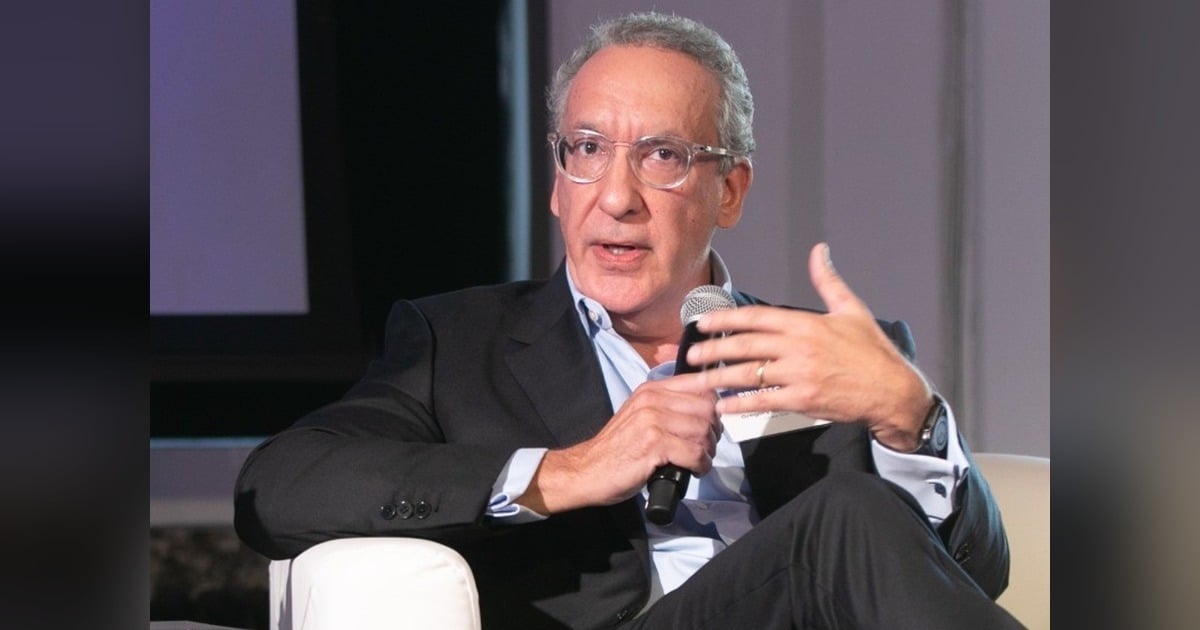
Drake Star CEO Greg Bedrosian on the post-SaaSpocalypse reset, why exclusivity is no longer the finish line, and where buyers will find value in 2027
By Greg Bedrosian, Managing Partner & CEO, Drake Star
A pioneer in cross-border M&A, Greg has personally closed 100+ high-profile deals with the likes of AT&T, Blackstone, Oracle, Paramount, and TPG to name just a few. He is a member of the Council on Foreign Relations, an advisor to Harvard Innovation Labs, and an M&A Advisor Hall of Fame inductee.
In M&A, if you lose a quarter, you’ve lost the year. That’s one of the truest lessons of my decades as an investment banker, because deals simply take that long. And the SaaSpocalypse cost software M&A a full quarter of deal activity in 2026.
The good news: The market is no longer frozen. Selective deals are getting done, at the large end and across the middle market. Drake Star had an active summer, and we expect an active Q4. Deals that should have closed in the first half are now second-half transactions, and some will slip into 2027.
But this is not business as usual. Here’s what we’re seeing on the ground, and what it means for founders, CEOs, and investors.
No one wants to make a mistake
That’s the defining mood in software M&A right now.
Buyers don’t want to be the one who sets the new benchmark, say 5 or 6x revenue where it used to be 10x (illustrative numbers, not specific deals), only to watch multiples fall further. Sellers, who all had higher multiples in mind, are coming to terms with what is likely a permanent reassessment of value.
S&P Global Chart on Software Valuations Historic Lows
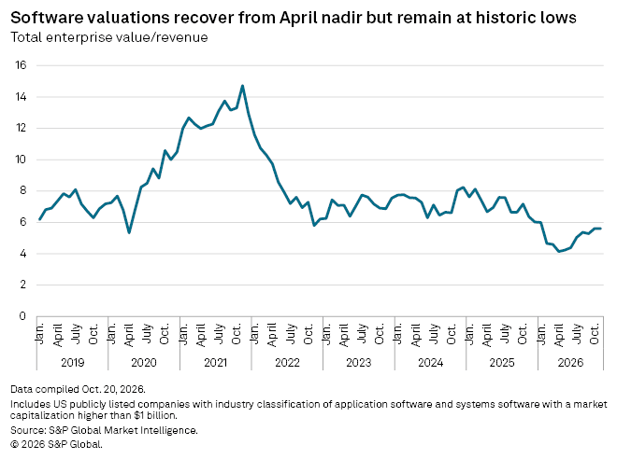
That forces a hard question on every owner, private equity or strategic: Can I improve this business enough over the next few years to outrun a new plateau in revenue multiples? Or should I sell now? Those aren’t easy conversations, and they’re slowing deals down.
Exclusivity is no longer the finish line
In a healthy M&A market, the path is familiar. You run an auction, narrow the field of private equity and strategic buyers, pick one, and go exclusive. The next 30 to 45 days are about confirmatory diligence and closing.
In 2026, exclusivity in some software deals has become something else: a second chance for the buyer to make sure they didn’t overbid. Probability of close is still higher once a buyer is exclusive and spending real money on lawyers, accountants, and advisors. It’s just not as certain as it would be in a normal market.
Exclusivity used to be the finish line. In 2026, it’s halftime.
What we tell our sell-side clients:
-
- Keep buyers number two and three warm.
- Be extremely prescriptive about the scope and timing of diligence.
- Assume deal risk carries all the way through exclusivity until closing.
“AI Day” and the art of the re-trade
Nearly every software deal now includes what I call “AI Day.” It usually lasts longer than a day, but it starts with a long one.
Most private equity firms, large and mid-market, now have an AI expert, in-house or external. Given how fast AI is evolving, I’m not sure anyone can be a true expert yet. But the premise of the meeting is always the same: Here’s a list of AI and other threats to your business, prove to me they don’t apply.
No seller scores 100% on that test. The real question is how comfortable you need to get the buyer.
AI is also becoming a negotiating weapon. In one recent process, a buyer came back after diligence and cut the price by 30 to 40%. Their argument was that, based on AI diligence, they weren’t sure the business had any terminal value, in part due to existential AI disruption risk.
Our response was simple. If there’s truly zero terminal value, why buy the company at all? Why isn’t the price zero? Odds are that they didn’t truly believe it. Our client declined to take the bait, decided to keep running their business, and that particular deal didn’t happen. That buyer may have overreached, but the tactic is out there, and sellers need to be ready for it.
Why private equity is the more cautious buyer
Strategics are broadly active. Private equity is more cautious, both in the market overall and in the deals we’re completing. The reasons go well beyond deal-by-deal judgment.
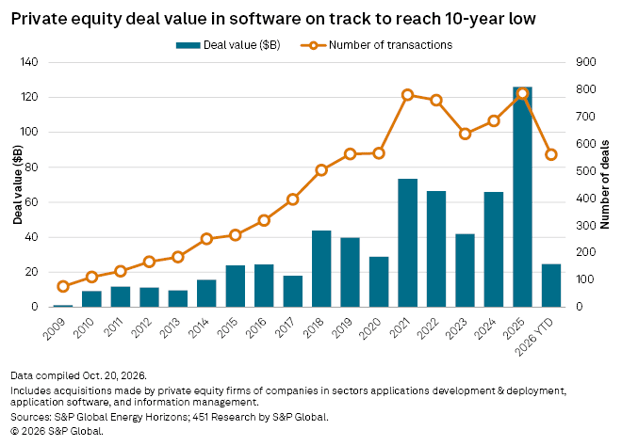
Legacy portfolios: Many tech-focused PE firms bought software in 2020 and 2021 at double-digit revenue multiples. Hypothetically, if a fund is full of assets bought at 10x and is now closing new deals at 5x, it raises an uncomfortable question: Should the existing portfolio be marked down 50%? No manager will say that out loud, but it’s in the back of their minds. They may end up exiting below 10x, but hopefully well above 5x.
LP patience: Tens of thousands of middle-market companies sit in PE portfolios, and we’ve been talking about the coming wave of exits quarter after quarter. It simply hasn’t happened. If I’m an LP still waiting on cash from 2020-2021 software investments, I’m asking why buying more will end differently. “We’re buying at half price” is one answer, but it reopens the question of where the old portfolio is marked.
Scale: Outside a handful of very large firms, most newer PE firms and teams focus on mid-size software businesses, which are more vulnerable by nature. There’s a very big difference between many billions of ARR and tens or hundreds of millions.
S&P Global Chart on PE Software Deal Value 10-Year Low
A healthier market, and real opportunity
Most tech-focused PE firms will come through this reset, and many will come out stronger. The ones with real operational expertise, who can actively improve the businesses they own, are already showing the way. So are firms mature enough to make the hard calls, including selling an asset at a loss to get capital back to their LPs. That’s disciplined investing, and LPs will reward it.
At the margin, every boom creates some overcapacity. A smaller group of firms, mostly at the lower end of the middle market, may not raise another fund. That’s a normal and healthy part of the cycle, and their best talent will move to the firms that are growing.
There’s also a lot of reinvention underway. Firms are repurposing their software teams into software + AI investing teams and even launching some AI-dedicated funds. That’s what makes finance so dynamic: When one door narrows, capital and talent move quickly to the next opportunity.
Expect some additional software restructurings and reorganizations too, off a relatively low base, mostly handled quietly with lenders in the mid-market.
Here’s the bigger story. Disruption doesn’t mean value destruction. It means value shifts from one type of owner to another. Where someone needs to sell, someone else gets an opportunity:
-
- Integrated, large-scale software platforms picking up talent and capability at far more reasonable valuations.
- Aggregators and thematic buyers who know how to operate these assets at scale. Some will look brilliant in hindsight.
- AI-driven buyers acquiring businesses for their data or customer base. For a trillion-dollar player, buying a company can save six months. (A caution: Plenty of owners pitch us that they’d be worth a fortune to an AI giant. Sometimes that’s true. Sometimes it’s a “Hail Mary.”)
- Carve-outs from mega-consolidation. Media’s latest megamerger comes with $6 billion of targeted synergies. That means niche divestitures, and talented people who may launch the independent leaders of the next decade.
When we look back on this era, some buyers are going to look very smart based on their dealmaking in the first half of 2027.
What founders and CEOs should do now
We’re seeing a clear uptick in software companies looking to hire investment banking advisors, most planning to go to market in the first half of 2027 once full-year 2026 numbers are locked in. And this time, they actually want to transact. Twelve months ago, sellers often gave us ambitious minimum-valuation ultimatums. We aren’t hearing those as much anymore.
If you’re one of them:
-
- Prepare for AI Day before it’s scheduled: Build the durability case yourself (or even the upside AI expansion case) before a buyer builds the threat case for you.
- Run a real, thorough process: Keep backup buyers engaged through exclusivity.
- Price to the market you’re in: The owners accepting the new plateau are the ones getting deals done.
- Know your comps: Be honest about your comps and what they do and don’t mean. If you have annual revenue in the millions, comparing yourself to mega tech companies with revenue in the billions hurts more than it helps.
Disruption doesn’t destroy value. It moves it. The only question is which side of that trade you’re on.
About Drake Star
Drake Star is an award-winning, independent, partner-led investment bank 100% focused on technology. The Drake Star global team of experienced professionals and senior advisors across offices in New York, Munich, London, Los Angeles, Paris, San Francisco, Berlin, West Palm Beach, and Dubai* focuses on mergers & acquisitions and corporate finance services worldwide in Software/SaaS, Artificial Intelligence, HR Tech, Digital Services, FinTech, Digital Media, Industrial Tech, Consumer & Retail Tech and Mobility & Sustainability.
Since 2003, the firm has completed 500+ transactions representing $22B+ in deal volume, primarily in the mid-market (with deal values typically ranging from $50 million to $500 million ). Roughly 70% of the firm’s transactions have crossed international borders. Drake Star advises tech CEOs and founders on sell-side M&A, buy-side M&A, and growth capital raises.
The firm works daily alongside leading growth investors, private equity firms, and strategic acquirers, including CVC Capital Partners, Insight Partners, Francisco Partners, Platinum Equity, PSG, Riverside, AT&T, Reddit, Netflix, and Shutterstock. Drake Star’s sector reports are widely followed across the private equity community, and its insights are regularly sought by Bloomberg, Reuters, the Wall Street Journal, CNBC, Forbes, S&P Global, TechCrunch, Handelsblatt, and Sifted. The firm has earned 70+ industry awards, including 50+ Deal of the Year honors and multiple Investment Bank of the Year awards.
Drake Star is the marketing name for the global investment bank Drake Star Partners Limited and its subsidiaries and affiliates. In the USA, all securities are transacted through Drake Star Securities LLC. In the USA, Drake Star Securities LLC is regulated by FINRA and is a member of SIPC. Drake Star UK Limited (FRN 942020) is an appointed representative of Razlin Ltd (FRN 730805), which is authorized and regulated by the FCA. © 2026 Drake Star Partners Limited.
For more information, visit www.drakestar.com.
*Partner Office
 Full
Biography
Managing Partner & CEO, Member of the Executive Committee
Consumer & Retail Tech
Digital Media
Digital Services
Artificial Intelligence
New York